 Spoolroom
Filament tracker for 3D printers
Know what you have. Plan your next print.
Keep filament and workshop supplies together. Bring purchases in, track filament usage, and check what you have before the next print or order.
Open beta · Free plan
Start on the free plan, no card needed.
Free includes 50 active spools and 2 printers.
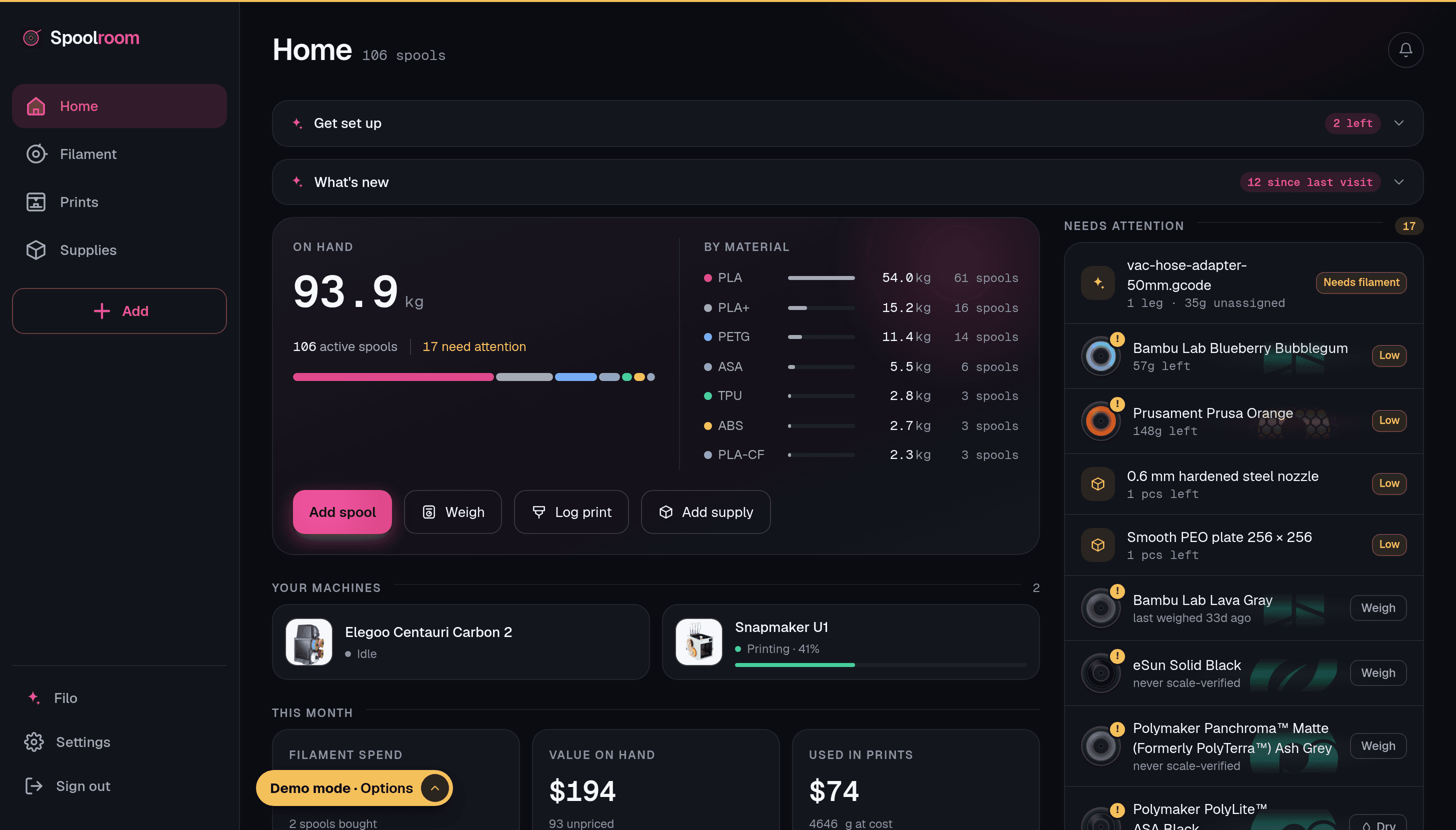
Example inventory from the Spoolroom demo. The current layout may differ.
From a purchase to the next print
Three jobs for your workshop shelf.
01 · Bring it in
Turn a purchase into inventory
Photograph a spool label or import a filament receipt. Review the suggested matches, quantities and fields before anything is saved.
02 · Find what you need
Keep supplies beside your filament
Track magnets, heat-set inserts and adhesives too. Record what a project used, or ask Filo what is on your shelf before buying more.
03 · Check the balance
Reweigh, then plan the next print
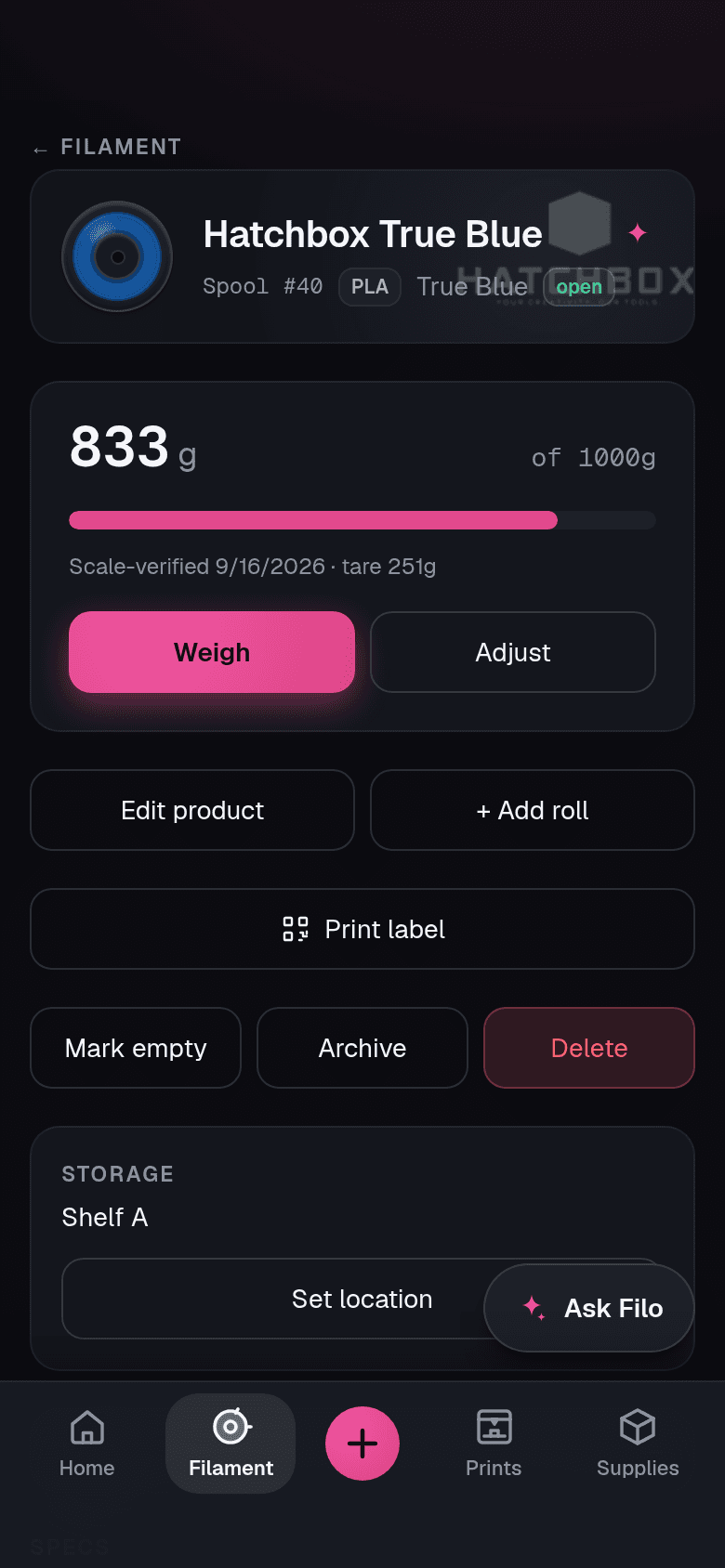
Reconcile a spool with a scale reading and keep the correction in its history. Load a sliced file to check the filament needed against your shelf, with a safety margin.
Photo intake, receipt import and Filo are optional. They need AI consent and available credits or your own provider key. Free has no included AI credits; receipt matches and unknown spool tares need your review.
Mobile first
Made for the phone in your workshop.
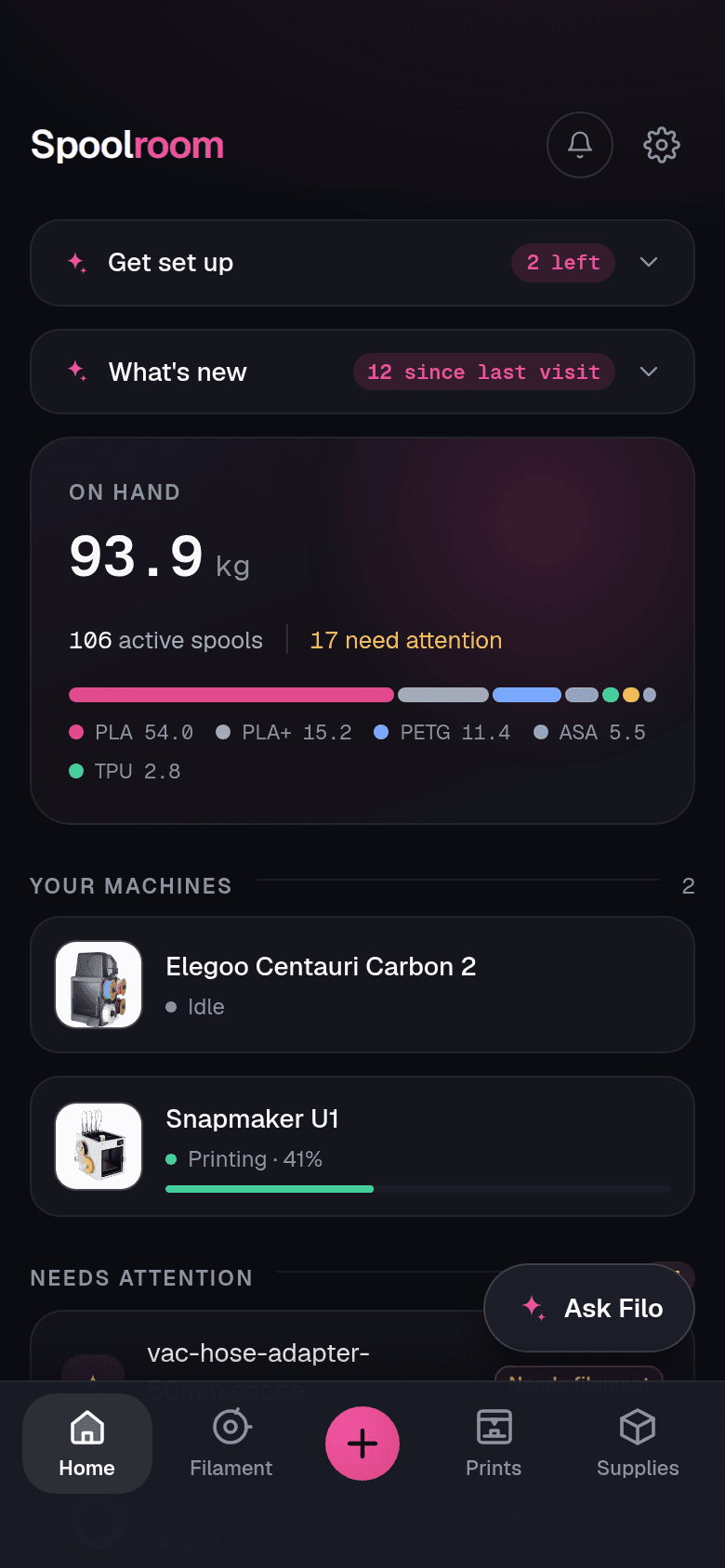
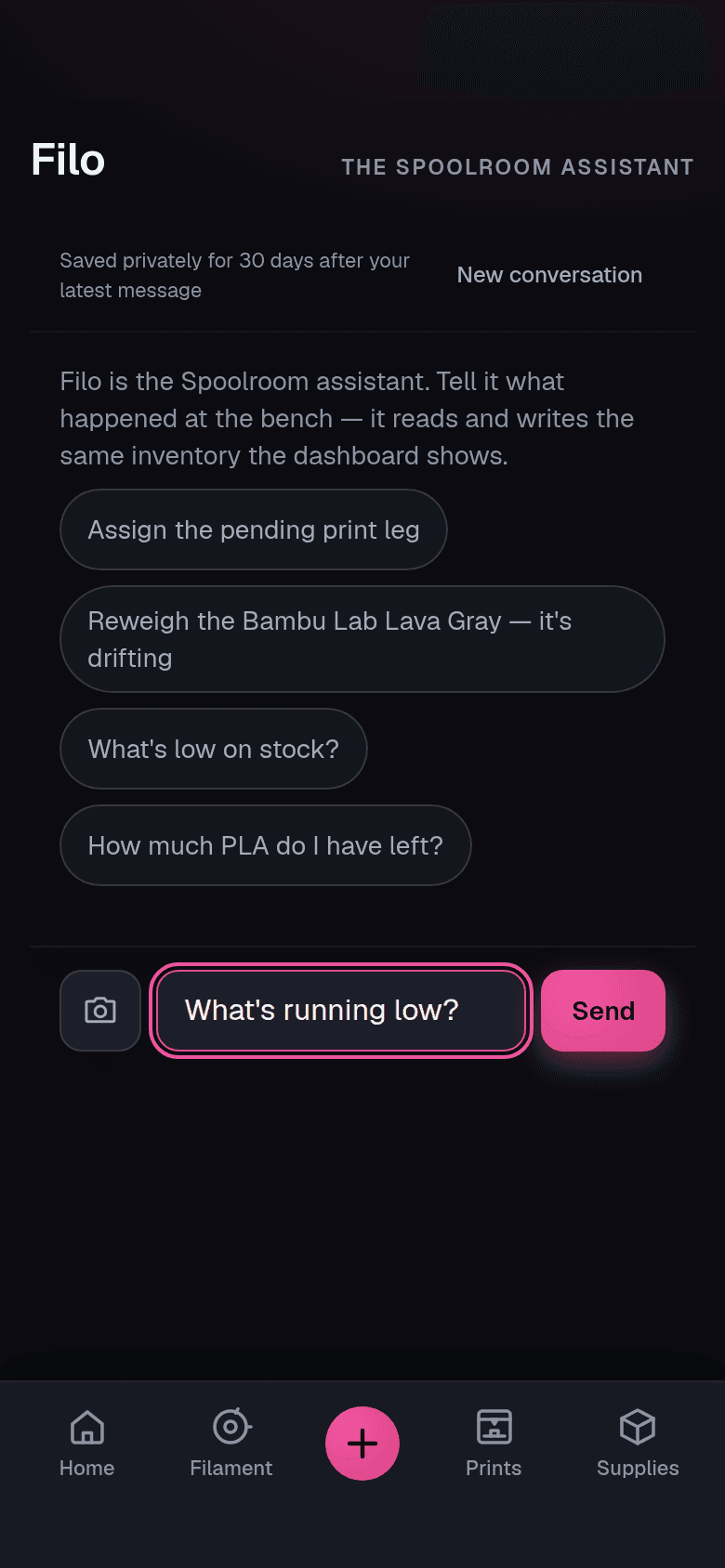
Check your shelf, reweigh a spool and ask Filo from your phone. Open the same inventory on a larger screen when you need more room.
Optional print logging
A read-only watcher on an always-on device on your network reports finished prints. Auto-logging is confirmed on the Snapmaker U1 and Elegoo Centauri Carbon 2; other listed printers are experimental. Uncertain spool assignments need review.
Print history and costs
See the filament used and cost recorded for each print. Export your print history as a CSV.
Maintenance reminders
Track service intervals by print hours or days. Record the nozzle, belt or other supply used when you do the work.
HueForge export
Export a filament library with measured transmission distance for HueForge.
Labels and QR
Print a sheet, stick them on, scan to the spool. Works from a phone at the shelf.
Your data is yours
Spoolroom is hosted, with no app server to maintain. Export your inventory and history whenever you need them.
Check your printer and watcher setup →
Coming for small shops: job costing, quotes and orders.
AI, on Claude
Three jobs the AI does. Every one ends with you.
Spoolroom uses Claude, Anthropic's model, for Filo, photo-to-spool and receipt import. It reads labels and receipts, answers from your real inventory, and drafts the change — then stops. Nothing is written to your shelf until you confirm it on screen.
Ask Filo
An assistant that reads the same ledger the dashboard shows and can act on it: what is low, what came off the scale, which spool covers tonight's print.
Photo to spool
A label photo becomes a spool record — brand, material, color, weight — matched against the catalog and filled in for you to check.
Receipt import
An order confirmation becomes the spools it bought, as records, in one pass.
- Only the request leaves. The photo you took, or your question and the inventory facts needed to answer it. Nothing else.
- Optional, and yours to steer. Everything else works with AI off. Bring your own Claude or OpenAI key and the AI runs on your account instead.
Find your fit
Choosing a filament tracker?
Start with the work you want to do: adding purchases, keeping balances useful, tracking supplies and connecting printers. See how Spoolroom and other tools approach those jobs, with sources and setup requirements together.
Compare filament trackers →Ask first
Questions? Filo is right there in the corner.
Filo is the assistant inside the app, and it rides along on this page too. This copy answers from a short list of notes, so it knows what Spoolroom is and how it behaves, and nothing else. The real one reads your shelf.
Which printers does it work with?
Confirmed on real printers: the Snapmaker U1 (Klipper with Moonraker) and the Elegoo Centauri Carbon 2. Other Klipper printers with Moonraker (Voron, Klipperized Enders) talk to the watcher the same way as the U1 and should work, but nobody has confirmed one yet. Experimental, built from published protocols and not yet tested on a real printer: Creality K1, K1C and K1 Max with root access and Moonraker installed, the Anycubic Kobra S1, S1 Max and Kobra 3, Bambu Lab printers, Creality K1, K2, Hi and Ender-3 V3 on stock firmware, Prusa printers through PrusaLink (MK4, MK3.9, MINI, XL, CORE One, CORE One L), the first Elegoo Centauri Carbon, FlashForge Adventurer 5M, 5M Pro and AD5X, and any printer run by OctoPrint. Other printers are not wired up yet. Without a watcher you can still log prints by hand or from a sliced file.
Does it work with Bambu Lab or Prusa printers?
Both, as experimental options not yet tested on a real printer. Bambu Lab: the watcher reads the printer over your own network with its LAN access code, with no Developer Mode and no change to your Bambu cloud setup. Prusa MK4, MK3.9, MINI, XL, CORE One and CORE One L: through PrusaLink, with the password from the printer's network settings. Either way it only reads, never controls.
How do prints log themselves?
The watcher is a small daemon that lives on a machine on your printers' network, an always-on box like a Raspberry Pi or a mini PC. It listens to each printer and reports finished jobs, so filament comes off the right spool with no typing. It only ever connects outbound, to Spoolroom.
Can it tell me if I have enough filament for a print?
Load a sliced file (Orca-family slicers, ElegooSlicer, Cura) and Spoolroom reads the per-tool grams and colors, matches them to spools on the shelf, and tells you whether it can cover the job with a safety margin. When the print finishes, those same legs come off those same spools.
Can I import my existing inventory?
There is a Spoolstock CSV importer that previews everything before it creates a single spool, and receipt import for order emails. The catalog is built from open filament databases, so most spools match a known product on the first try. Its sources are credited on the data sources page.
Is my data mine?
Yours. One click in Settings exports everything as JSON, any time: every spool, event, print and note. There is a HueForge library export and CSVs of your spools and of your prints and their costs as well. Leaving never means losing it, and deleting the account deletes the data.
What does the AI do?
Three things: Filo, an assistant that reads and writes the same inventory the dashboard shows; photo to spool; and receipt import, which turns an order confirmation into spools. They run on Claude, Anthropic's model, through the Claude API. Every one of them ends in a confirm screen before anything is written, and you can bring your own Claude or OpenAI key instead.
Do I need a password?
No passwords. You sign in with a passkey (Face ID, Touch ID, a security key) or an emailed magic link. Nothing to remember and nothing to leak.
Do you show ads or track me?
No ads, no advertising trackers, nothing sold. Error reports and page speed are the only telemetry, never what you looked at. The watcher on your network only talks outbound to Spoolroom; nothing listens in. Your inventory is yours to export or delete.
Does it work offline?
It runs in the browser as a PWA: add it to your home screen and it opens like an app. The shell and the pages you have opened stay available without a signal, so the shelf list still opens in a basement workshop. Writing needs a connection, because the scale number has to reach the ledger.
Can I self-host it?
Spoolroom is hosted; the watcher is the only part that runs on your side, and it only connects outbound. Self-hosting the whole app is not something on offer today.